Friday, February 11, 2022

TOEIC Preparation - Week 3

   TOEIC Preparation - Week 3


Warm Up: You saw that Knock Knock Jokes are a very common style of jokes in English that involve similar sounding words. To tell a knock knock joke, you must pretend that you are knocking on a person's door. The knock knock joke always follows the same pattern.

  • Joke Teller: "Knock Knock"
  • Listener: "Who's there?"
  • Joke Teller: "X"
  • Listener: "X who?"
  • Joke Teller: ...THIS IS "SUPPOSED TO BE" THE FUNNY PART

With your partners take turns clicking on the links and telling your knock knock jokes. You do NOT need to share your screen for this activity. If someone does not understand the joke, you can say it again. If nobody understands the joke, write down the number so you can discuss it with your teacher later.

Knock-Knock Jokes


Similar Sounding Words as Distractions

Task 1: Identify Common Distractor Types
One of the most common distractor types in Parts 1 and 2 of the test are the use of similar sounding words. In this exercise you will practice identifying words that rhyme. On the top of page 1 of the worksheet section of your anthology, draw the same shape around each of the words that rhyme. In the final column, you need to make your own symbol or letter system to identify the categories of rhyming words. 

Click to see full size image
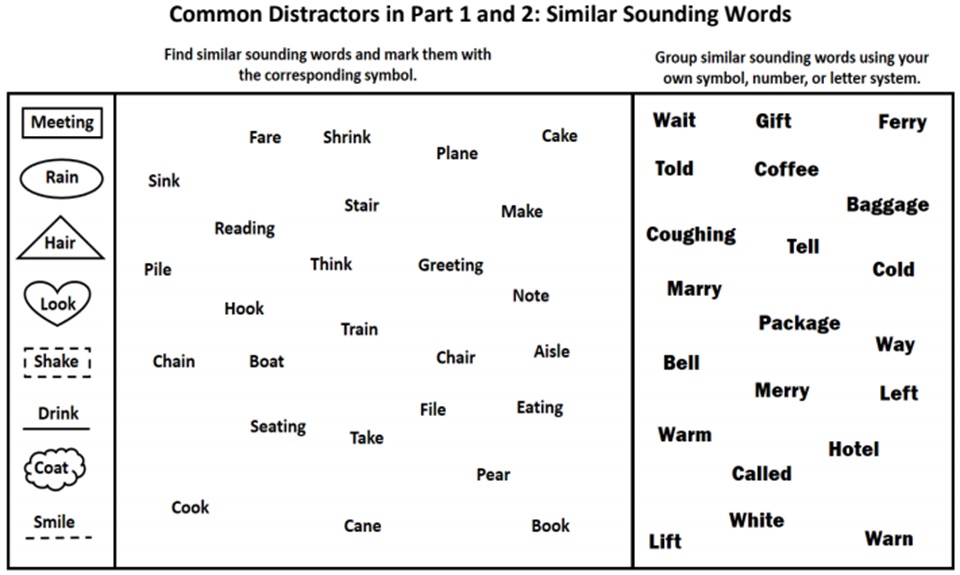

Task 2: To practice some of the common distractor types for Part 1 of the test, draw a line to connect items from the three columns (Type, Description, Example) on the bottom of page 1 of the worksheet section of your anthology.

Click to see full size image


What is the Question Asking?

Introduction: The biggest strategy for Part 2 is to pay very close attention to what the question is asking. Once you know that the question is asking about a person, place, time, etc., it will be much easier for you to identify which responses are appropriate and which are not. The graphic below contains some common question categories. 

Click to view full size.


Task 3: Make two teams, A and B. For the first round, Team A is going to CLICK HERE. Team B should NOT look at it! Team A is going to read some different questions and Team B will quickly say what category the question belongs in. 

Task 4: Now it's time for Team B to read the questions and Team A to categorize them. Team B is going to CLICK HERE. Team A should NOT look at it!

Task 5: Now both teams are going to take turns playing another quick thinking game. Team A says the name of a student from Team B and then reads one of their original questions. The student on Team B needs to respond to the question with a socially appropriate answer. Then Team B calls the name of a student from Team A and reads a question. The idea is to see how quickly you can do this!


Book Exercises


Page 10 - Task A
Click to see full version.


Question Analysis

Instructions: Click your group link below. You will see 10 prompts. For each one, you need do the following:
  • Idenitfy what kind of information the question is asking.
  • Write a plausible answer to the question.
  • Look at the real answer choices and select the best option.
  • Classify the two distractors.


Focused Practice


Instructions: Work with your partners to complete some collaborative quizes. Choose the kind of questions you want to focus on below. Remember to check the transcripts after you submit your answers.

Tuesday, February 8, 2022

Design of Teacher Training Programs - Week 3 - Models for Course Design

   Design of Teacher Training Programs - Week 3 - Models for Course Design


Introduction: Hello and welcome to Week 3 of the course Design and Evaluation of Teacher Training Programs and Workshops for the Master's in English Teaching at ULACIT. In this class we will do everal activities to explore different models for course design to see what they have in common, discuss the benefits of taking a systems approach to course design, review the guidelines for your needs and context analysis assignment, and discuss the benefits and challenges of peer and self-observation as professional development strategies.

Today's Goals:
  • T: Compare and contrast several classic models for curriculum design.
  • T: Discuss the benefits of taking a systems approach to training program design.
  • T: Review and clarify the instructions for the Training Needs Analysis Task.
  • PD: Share and compare your takeway tip from the chapter "Find out how you teach"
Guiding Questions:
  • T: How can curriculum design models inform our approach ot training?
  • PD: How can I find out how I teach?


Task 1: Things that I used to do
CLICK HERE to access the document. Think about your years of teaching experience. What specific examples can you give for each of the following categories?

Click to see full size image.

  • How have your attitudes, beliefs, practices and habits related to teaching changed over the years?
  • What drove those changes? Where any of the changes made consciously? If so, what prompted them?
  • How might you become more aware of your ongoing growth and change as a professional?


Task 2: Sharing your PD Journal
Last week you read the section "Find out how you teach" in the Richards (2017) book and you selected at least one PD tip to react to. Let's take a moment to share and compare.
  • Use lesson reports to monitor your teaching
  • Watch or listen to yourself teaching
  • Observe each other teaching
  • Keep a portfolio
  • Keep a journal


Task 3: What is Curriculum?
This is a course on teacher training, not curriculum. However, designing effective training programs requires us to think beyond the limits of a single workshop and consider the design of an overarching structure that our workshops and other learning experiences are a part of. Discuss the following questions with your teacher and classmates.
  • Think of a coures that you took as a student (at any level) that you consider to be effective. 
  • What made it effective?
  • How was the course structured?
  • What kinds of tasks were you required to do?
  • How did they contribute to your learning?
  • Think of a course that you have taken (or taught) that you did not consider to be effective? What structural changes could be made to improve it?
  • As teachers we are much more familiar with designing learning experiences at the lesson level. What do we need to consider in order to begin designing courses?


Task 4: Comparing Course Design Models
The following course design models were referenced by Graves (2000) in Chapter 1 "A Systems Approach to Course Design." Briefly look at each one and describe your interpretations. You do not have to be an expert in this. 
  • What do you think the different stages mean? 
  • How are the models similar and different?
Click to see full sized image. 


  • What does the Graves model have that is also present in the other models?
  • What is different about the Graves model?


Task 5: Your Reading Takeaways
Share your takeaways from this reading response task. If you completed the study guide, you should be able to provide intelligent answers to the following questions.
  • Designing a course involves ________. 
  • What are the elements of course development?
  • What is a systems approach?
  • How does it help explain the process of course development?
  • What strengths does a systems approach have over linear models of curriculum development?
  • Why is designing a training course a work in progress?


Task 6: Instructions for Needs and Context Analysis
CLICK HERE to review the guidelines document for your upcoming assignment. 
  • Who are your group members?
  • What educational institution are you planning to work with?
  • What specific focus have you thought of giving your training course proposal?
  • What kind of information do you think you will need to gather to adequately consider the needs and context?


Teaching Grammar - Week 3 - What makes a good grammar explanation?

 Teaching Grammar - Week 3 - What makes a good grammar explanation?


Introduction: Hello and welcome to Week 3 of the course Teaching Grammar for the Licenciatura in English Teaching at ULACIT. In this class we will do several activities to explore some basic grammar terminology and we will also explore the principles of a strategy for presenting and clarifying grammar called Guided Discovery.

Today's Goals:
  • Clarify your understanding of the functions of the 8 parts of speech.
  • Discuss your criteria for an effective grammar explanation.
  • Analyze the transcript of a guided discovery presentation to identify the functions of the teacher's interventions. 
  • Participate in a guided discovery activity and articulate its strengths and challenges as a grammar activity type.

Guiding Questions
:
  • What are the functions of the eight parts of speech?
  • What makes a good grammar explanation?
  • How can teachers help students make discoveries about how grammar works?


Task 1: Part of Speech Rally
To start today's class you are going to do a competitive activity to review the 8 parts of speech. Click your group link below. You have a maximum of 10 minutes so work as quickly as you can. If you get stuck, just move on!


Task 2: Basic Grammar Labels for Sentence Structure
For homework you read a complicated section from Folse regarding the basic labels for sentence structure and you completed a study guide to help you organize and process this information. We do not have time to review this in class today so I created this short video presentation to clarify some of the most important points. Feel free to check it out in your own time. 


Task 3: What makes a good grammar explanation?
Discuss the following questions with your classmates.
  • In your experience, what are the characteristics of an effective grammar explanation?
  • What are some alternative ways to introduce and clarify new grammar structures?
  • What is the role of teacher questions in the process of grammar explanation?
  • Are you familiar with the concept of "guided discovery"? If not, what do you think the term might mean?


Task 4: Analyzing a Guided Discovery Presentation
Now we will look at a transcript of a lesson in which a teacher uses the guided discovery technique to introduce and clarify a new structure. We will read and analyze the transcript as a group and identify the specific techniques the teacher uses to help guide students in their discovery of how this grammar topic works. 


Task 5: Guided Discovery Activities
We can also take the principles of guided discovery in presentations and apply them to grammar activity worksheets. The idea is have students perform a series of tasks that will help them discover the important features of the new structure. Work with your partners to complete this guided discovery worksheet I created to help students understand the passive voice.
  • CLICK HERE to see another example of a guided discovery activity I created to help students review the form and functions of the present perfect. 


References:

Folse, K. (2017). Keys to Teaching Grammar to English Language Learners: A Practical Handbook (2nd ed.). University of Michigan Press. 

Scrivener, J. (2005). Learning Teaching. Macmillian.

Saturday, February 5, 2022

Diseño de Materiales - Week 2 - Materials, Courses, Teachers

 Diseño de Materiales - Week 2 - Materials, Courses, Teachers


Introduction: Hello and welcome to Week 2 of the course Diseño de Materiales. In this class we will explore the Dogme Manifesto and give our opinions about their claims, talk about the four functions of materials in language teaching, and review the benefits of taking a cyclical approach to materials selection.

Today's Goals:
  • *Review the course content, evaluation structure, and important dates from the syllabus.
  • Consider arguments in favor of a materials-light approach to ELT and give your opinions.
  • Discuss key concepts from the chapter Materials, Courses, Teachers.

Guiding Questions:
  • What are the arguments against the heavy use of materials in ELT?
  • How do I feel about these arguments?
  • How can materials be classified?
  • What are the advantages to a cyclical approach to materials selection?

Community Builder: How Much is Too Much?
Tell your partners about the perfect amount of the following items.


Task 1: Reading Reactions
Discuss the questions below about Chapter 1 in McGrath (2016). Feel free to refer to your study guide if you need to. 
  • What are ways that materials can be used in the language class? Tomlinson describes four functions of materials.
    • What do they mean?
    • Can a single material serve more than one of these functions? If so, provide an example.
    • Which function do your materials serve the most? Why do you think that is?
    • Which function is addressed less often by your class materials? Why might that be? 

  • For better or worse, coursebooks have become the dominant form of materials in most ELT contexts over the last decades. Why do you think that is?
  • How would you describe your relationship with the coursebook you use now or have used in the past? Read and react to these statements. Do they match your feelings about coursebooks?
    • The coursebook is my boss. It tells me what to do.
    • The coursebook is my helpful companion. It gives me good ideas.
    • The coursebook is just there. It adds nothing of value to my teaching.
    • The coursebook is my enemy. It brings negativity to my life.
    • The coursebook is my "frenemy". We have a complicated relationship.
    • The coursebook is ... (add your own ideas)
    • The coursebook is ... (add your own ideas)
  • What is the difference between coursebook-.ed teaching and coursebook-based teaching? Which discribes your current use of coursebooks? Did you use coursebooks differently in the past? Do


DOGME: A Noble Experiment


Introduction: Is there an argument for a materials-light approach to language teaching? Well, a group of English teachers in 2001 were disillusioned with the current state of ELT and they got together in an online community (a new concept at the time) and created a radical approach to teaching foreign languages. The named their approach DOGME in honor of an experimental movement in cinema of the same name that had been popularized a few years earlier. Through DOGME, these teachers hoped to put the learners and their needs at the center of the teaching-learning process. 

Scott Thornbury, the group's unofficial leader, stated in his 2006 book An A-Z of ELT, "Dogme ELT argues for a pedagogoy of bare essentials, that is, a pedagogy unburdened by an excess of materials and technology, a pedagogy grounded in the local and relevant concerns of the people in the room (p. 70)"

Task 2: Dogme Manifesto
The DOGME group outlined their core beliefs in the following manifesto. Read each declaration carefully and answer the following questions.

  • What does it mean? Do understand what it is trying to say?
  • What do I think about it?
  • To what degree does it match my own views about language teaching-learning?


The DOGME Manifesto: 2001


Task 3: Group Discussion
  • Which of the statements from the manifesto stand out to you? Why?
  • What could be the authors' rationale for expressing these statements?
  • Which statements have some connection with the topic of didactic materials?
  • CLICK HERE to view a summary document that your teacher will use to help you better understand some of the philosophy behind the movement. 

  • Did the summary help you better understand the motivations of the DOGME movement?
  • DOGME was created in reaction to what these teachers saw as a decline in the effectiveness of ELT. What might these statements suggest about the reality of the teaching contexts in which these teachers were working?
  • DOGME was created before our current online pandemic teaching paradigm. Which of their beliefs might still be applicable in our current context? Are of the beliefs more applicable now?
  • For many reasons, DOGME is too radical to be a practical approach to language teaching in a formal context. However, what can we rescue from this noble experiment? 
  • How can some of these ideas influence your own approach to materials evaluation, design, and use?


References

McGrath, I. (2016). Materials Evaluation and Design for Language Teaching (2nd ed.). Edinburgh University Press.

Meddings, L. & Thornbury, S. (2009). Teaching Unplugged: Dogme in English Language Teaching. Delta Publishing.

Thornbury, S. (2017, June 26). M is for Manifesto. An A-Z of ELT. https://scottthornbury.wordpress.com/2017/06/25/m-is-for-manifesto/

Thornbury, S. (2006). An A-Z of ELT. Macmillan Education. 


Friday, February 4, 2022

TOEIC Preparation - Week 2

 TOEIC Preparation - Week 2


Task 1: Preposition Practice 
You already practiced hand gestures for these prepositions with your teacher. Now it's time for you to practice with your partners. In each group one person will be the leader. The leader will do different gestures and the partners will say the preposition they see. The leader will go quickly so that it is difficult. Then after a minute, the leader will not do anymore gestures. He or she will only say a preposition and the partners have to do the corresponding gesture. After a few minutes, you can change the leader and try again. 

Click the picture to see the full version.


Task 7: Identifying Physical Relationships with Prepositions - Click on the pictures below and analyze them. What object can you identify in the picture? What prepositions can you use to describe them? Look at the sentences. What prepositions would make senses in those examples? 

Click the pictures to see the full version.


Now for the last picture, work with your partner to create sentences to describe the relationships between the people and objects in the photo. Try to use as many different prepositions as possible.

Click the picture to see the full version. 


Task 2: Facts or Opinions?
Look at the images and the descriptions below them. For each one, decide if it is a fact about the photo or an assumption. You do not need to write, only discuss.


1. The businessmen are having a meeting. (Fact / Assumption)
2. Some people are sitting on the grass. (Fact / Assumption)
3. The friends are about to play a game. (Fact / Assumption)
4. There are some clouds in the sky. (Fact / Assumption)
5. Some of the men are wearing jackets. (Fact / Assumption)


1. The repairmen are discussing a problem. (Fact / Assumption)
2. The light is difficult to fix. (Fact / Assumption)
3. The stepladder is very heavy. (Fact / Assumption)
4. There is a sign above the door. (Fact / Assumption)
5. Both men are looking up at the light. (Fact / Assumption)


1. The man is carrying plates of food. (Fact / Assumption)
2. He is about to serve some customers. (Fact / Assumption)
3. The waiter is working very hard. (Fact / Assumption)
4. The man is wearing a long-sleeved shirt. (Fact / Assumption)
5. The restaurant is very busy. (Fact / Assumption)


1. The tourist is taking a photograph. (Fact / Assumption)
2. The woman is wearing sunglasses. (Fact / Assumption)
3. There are some cars in the background. (Fact / Assumption)
4. The camera has failed to function. (Fact / Assumption)
5. She is holding something in her hands. (Fact / Assumption)


Task 3: Analyzing Photos
Click your group link below and complete the document with your partners.


Task 4: Group Practice
Now you will complete a short quiz to put into practice what we have been studying. One person should share their screen AND computer sound. Then you can take the quiz together. If you need to listen to part of the audio again, you can do it before moving to the next section. When you finish, check your answers. Say what is wrong with the incorrect distractors. 

Tuesday, February 1, 2022

Teaching Grammar - Week 2 - What Knowledge Does an English Teacher Need?

 Teaching Grammar - Week 2 - What Knowledge Does an English Teacher Need?


Introduction: Hello and welcome to Week 2 of the course Teaching Grammar for the Licenciatura in English Teaching at ULACIT. In this class we will do several activities to explore the topic of teacher knowledge in foreign language teaching and we will also look at one of the most common types of grammar practice exercises, the drill.

Today's Goals:
  • Discuss what kind of knowledge foreign language teachers need to be successful at their job.
  • Discuss possible answers to the "inert knowledge problem" regarding learner errors.
  • Explore the use of drills in grammar practice, their characteristics, strengths and weaknesses.

Guiding Questions
:
  • What aspects of English grammar do I feel comfortable teaching and which do I find challenging?
  • What knowledge does an English teacher need to have to teach effectively?
  • Why do students make errors and how should teachers deal with them?
  • In grammar learning, does practice make perfect?


Task 1: What do I tell them?
To start today's class you are going to participate in an improvised role-play activity. Click the link below and follow the instructions. One person in the group should share the screen.


Task 2: Group Discussion 
Discuss the following questions with your teacher and classmates and compare your answers with some of the improtant quotes from your study guide.


What is Grammar?
  • Based on the reading and your own common sense definition, what is grammar?
  • How is grammar that native speakers learn in high school different than the grammar language learners need?

Does the Teacher's L1 Matter?
  • How comfortable would you feel answering the students' questions from the previous activity?
  • Does being a native speaker qualify someone to teach a language?
  • What is the general perception of the public (laypeople) about value of native speaking teachers?

Why Do Students Make Errors?
  • Why do students make grammar errors and what should the teacher do about them?
  • What are some common errors that are caused by first language influence?
  • Should teachers correct all errors or "put up with" some kinds of errors for a time?

What Does the Author Say?
  • CLICK HERE to view some direct quotes from Folse (2017) about these questions. These quotes are also in your study guide. 


Task 3: Drills: The Typical Grammar Practice Exercises
Structure based drills are the most common form of grammar practice exercise in ELT. Although there are many variations of drills, they all share some common characteristics, strengths, and challenges. Click your group link below to explore this activity type in more detail.


References:

Folse, K. (2017). Keys to Teaching Grammar to English Language Learners: A Practical Handbook (2nd ed.). University of Michigan Press. 

Scrivener, J. (2005). Learning Teaching. Macmillian.

Ur, P. (2012). A Course in English Language Teaching. Cambridge University Press.